
Satellite Attitude Control with Just One or Two VSCMGs
Authored by A. Huang
For small satellite missions using VSCMG-based attitude control, the number of VSCMGs in the system is a configuration decision that carries real performance consequences. A single VSCMG, paired with magnetorquers, is sufficient for three-axis attitude control. Two VSCMGs, installed at non-parallel gimbal orientations, cover all three axes with gyroscopic torque directly. The performance difference between these two configurations is not readily apparent from actuator specifications alone, and no published data comparing them across a realistic multi-mode mission scenario has been identified in the open literature.
This article presents results from a simulation that ran both configurations through an identical four-phase mission profile, covering detumbling, LVLH nadir pointing, sun tracking, and a return to LVLH, executed as a continuous end-to-end scenario in a 510 km sun-synchronous orbit. The simulation reveals that the performance difference is concentrated in the precision-pointing phases rather than during detumbling. The results also indicate which actuator limitations drive the gap between the two configurations. For ADCS engineers evaluating actuator architectures early in a mission, the data provides a useful reference for system-level trades.
For background on why CMGs are entering the actuator trade at this satellite scale, and how growing SmallSat mass is shifting ADCS design decisions, see our earlier analyses:
-
SmallSats Are Getting Larger. What Does That Mean for Attitude Control?
-
Reaction Wheels and Control Moment Gyroscopes in Satellite ADCS: A Technical Comparison
Axis Coverage in a Single-Gimbal VSCMG
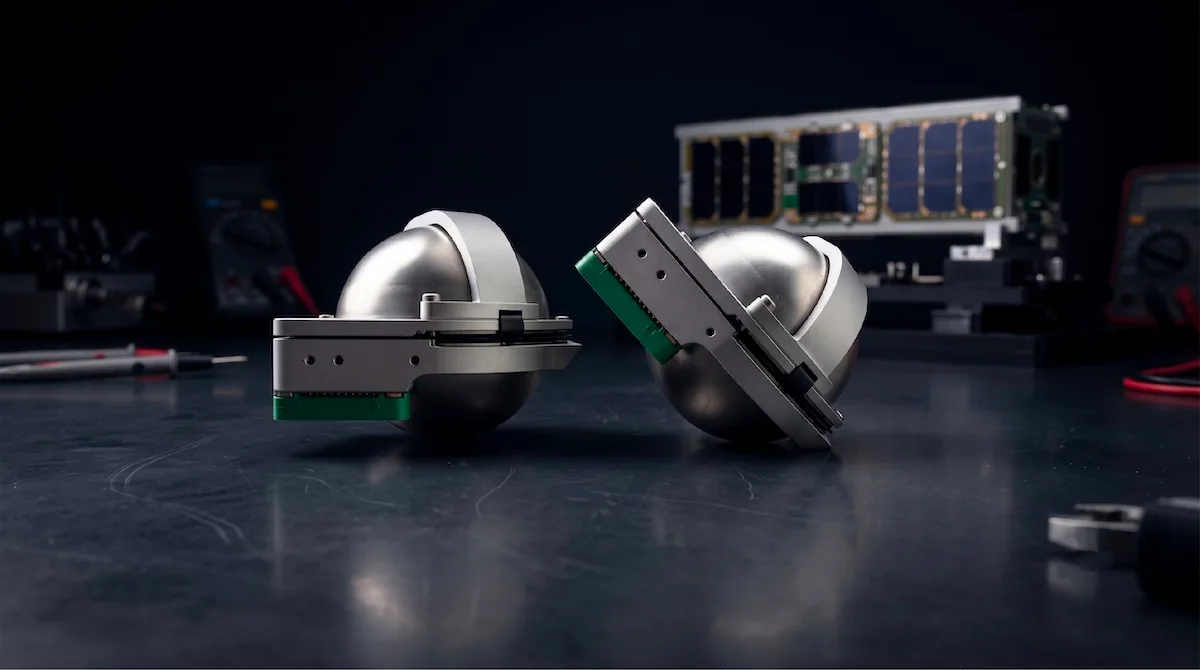
The TensorCMG is Tensor Tech’s variable-speed CMG (VSCMG). Its torque output covers two axes: the spin torque τs along the rotor axis, and the gyroscopic torque τt in the transverse direction perpendicular to the gimbal axis. The gimbal axis itself does not produce torque. A single VSCMG unit directly controls attitude on two axes, with magnetorquers covering the third axis control..
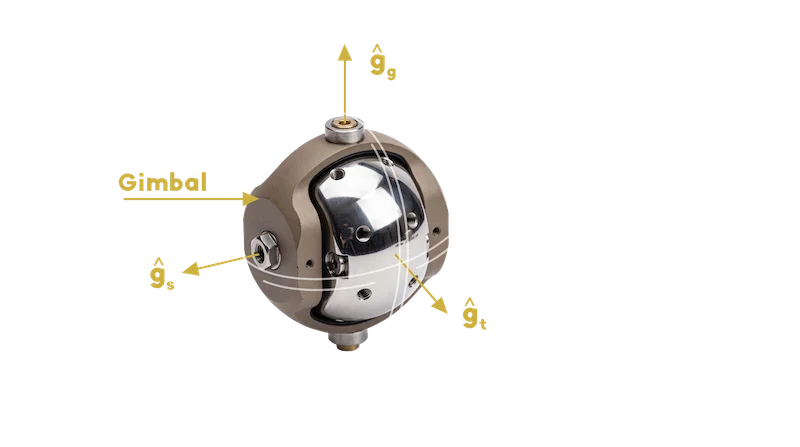
Figure 1. VSCMG torque axes of TensorCMG: The rotor spin axis (ĝs) and transverse axis (ĝt) are the two attitude control outputs. The gimbal axis (ĝg) drives gimbal rotation.
In a configuration with one VSCMG, magnetorquers fill that role. Magnetorquers generate torque by interacting with Earth’s magnetic field. Their output is orders of magnitude lower than the gyroscopic torque a VSCMG produces.
The gyroscopic torque τt of the TensorCMG-10m reaches a typical value of 15 mNm and a maximum of 100 mNm, while magnetorquer used in the TensorADCS-10m and TensorADCS-20m (0.2 Am2) operates in the μNm range in LEO. Two VSCMGs at non-parallel gimbal orientations cover all three axes with gyroscopic torque alone, without requiring magnetorquers for primary attitude control.
Simulation Setup
The simulation compares two configurations on the same small satellite platform in a 510 km sun-synchronous orbit. The single-CMG configuration uses one VSCMG paired with a three-axis magnetorquer. The dual-CMG configuration uses two VSCMGs with non-parallel gimbal orientations, also paired with a three-axis magnetorquer. Both configurations share an identical sensor suite: one gyro, one three-axis magnetometer, and six fine sun sensors, with a control update rate of 4 Hz.
The simulation runs as a continuous end-to-end scenario across four sequential phases: Detumbling (0–9,800 sec), LVLH Pointing (9,800–38,300 sec), Sun Tracking (38,300–40,300 sec), and a return to LVLH Pointing (40,300–41,700 sec). This sequence was designed to reflect a mission profile with mode transitions, not a single steady-state condition. Eclipse phases are included throughout, with the fine sun sensors inactive during these periods.
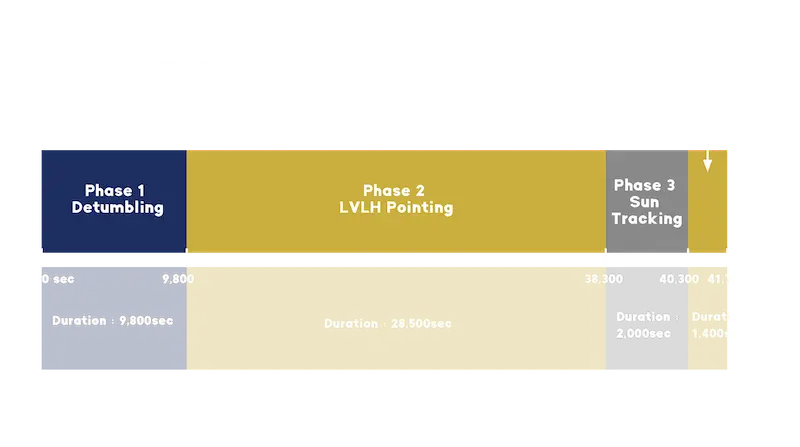
Figure 2. Four-phase mission timeline for the simulation scenario in a 510 km Sun-Synchronous Orbit. Total duration: 41,700 sec.
Source : https://drive.google.com/file/d/1MZB5hoilzkSjXEttPRHC85MSA_w8BaqH/view
Full system parameters, inertia properties, initial conditions, and VSCMG orientation matrices are documented in the complete simulation report.
What the Simulation Shows
Before comparing the results, it is important to note that the pointing error metric is defined differently for LVLH pointing and Sun Tracking.
-
For LVLH mode, pointing error is a quaternion-to-quaternion comparison, representing a three-axis rotational angle error measured relative to the target LVLH attitude.
-
For Sun Tracking mode, it is an axis-to-axis comparison, representing the angular offset between the actual sun vector and the target body axis.
These two definitions measure different quantities and are not directly comparable across phases.
| Performance Metric | Single-CMG configuration | Dual-CMG configuration |
|---|---|---|
| Phase 1: Detumbling | ||
| Time to Stabilize | ~9,000 sec | ~9,000 sec |
| Phase 2: LVLH Pointing | ||
| Pointing Error RMS (3-axis) | 0.3665° | 0.3197° |
| Settling Time | ~900 sec | ~200 sec |
| Phase 3: Sun Tracking | ||
| Pointing Error RMS (2-axis) | 0.4492° | 0.3538° |
| Settling Time | ~400 sec | ~150 sec |
| Phase 4: LVLH Pointing | ||
| Pointing Error RMS (3-axis) | 0.3845° | 0.2841° |
| Settling Time | ~600 sec | ~200 sec |
RMS values are calculated over the stable time window where error is consistently below 1°. The settling time is the duration after which the pointing error remains consistently within 1°.
Phase 1 shows no meaningful difference between the two configurations. The gap opens in every phase that requires precision pointing. Across all three precision pointing phases, the settling time for the single-CMG configuration exceeds that of the dual-CMG configuration by a factor of 2.7 to 4.5.
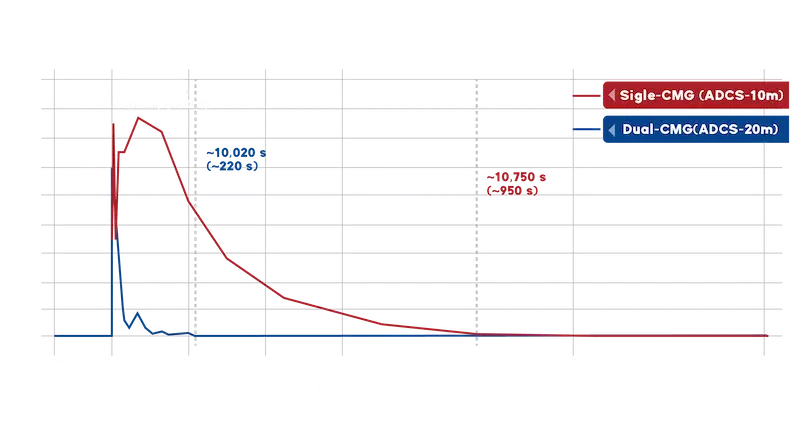
Figure 3. Pointing error versus mission elapsed time at the Phase 2 mode transition (t = 9,800 s). The dual-CMG configuration (ADCS-20m) settles at approximately t = 10,020 s (220 seconds after transition). The single-CMG configuration (ADCS-10m) settles at approximately t = 10,750 s (950 seconds after transition). Curves are approximate representations derived from simulation data.
Source : https://drive.google.com/file/d/1nLcuG5EEq3-IaeaVTrP-AiOVy2IpEnoJ/view
Source of the Performance Gap
The source of the settling time gap is the actuator asymmetry between the two configurations. The single-CMG configuration must rely on significantly weaker magnetorquers for control authority around one axis. The dual-CMG configuration uses its CMGs for rapid, three-axis maneuvering.
There is a second operational difference with longer-term consequences. The dual-CMG configuration allows its magnetorquers to continuously dump CMG momentum while attitude control is running in parallel, managing rotor speed to a level that balances power consumption against available gyroscopic torque. The single-CMG configuration cannot perform momentum dumping while the system is prioritizing attitude control. Momentum stored in the rotor accumulates until it reaches a saturation threshold, at which point the system must enter a momentum dumping mode. Attitude control is set aside until the rotor speed returns to a designated nominal value. Pointing performance is not prioritized during this interval. This saturation scenario was not included in the current simulation.
What This Means for Your Mission
If your mission profile includes transitions between attitude modes, the settling time determines how quickly the spacecraft becomes operational after each transition. The simulation results show a consistent gap of 2.7 to 4.5 times in settling time between the single-VSCMG and dual-VSCMG configurations, across three distinct precision pointing phases. Whether that gap is mission-critical depends on observing window constraints, power margins, and how frequently mode transitions occur in your operational timeline.
The full simulation report includes spacecraft parameters, inertia properties, VSCMG orientation matrices, control architecture assumptions, and complete time-series results for all mission phases.
You can log in to the Download section and find the simulation report under the Other category.