
Magnetorquer Functions, Configurations, and Applications in Satellite Missions
Authored by Afan Huang
In our previous article, we explored the fundamental principles of magnetorquer technology and how these electromagnetic devices generate control torques through interaction with Earth's magnetic field. Understanding the τ = m × B relationship and system integration concepts provides the foundation for appreciating the practical value magnetorquers deliver throughout satellite operations.
This article examines magnetorquers from a functional and application perspective. We'll explore three core operational functions that make magnetorquers indispensable: stabilizing satellite attitude against environmental disturbances, recovering from tumbling after deployment, and managing momentum in hybrid control systems with reaction wheels. Additionally, we'll survey how different satellite mission types—from university research platforms to commercial Earth observation systems—leverage magnetorquer technology to achieve their operational objectives.
Finally, we'll compare the two primary magnetorquer configurations available to mission designers: flat air coil and rod-shaped iron core designs. Understanding these practical applications and hardware options will help you evaluate how magnetorquers can serve your specific mission requirements.
Core Functions of Magnetorquers
Stabilizing Satellite Attitude
Disturbance Forces in Low Earth Orbit
The primary function of magnetorquers in CubeSat missions is maintaining stable satellite attitude during nominal operations. Once a CubeSat has achieved its desired orientation, magnetorquers provide continuous corrective torques to counteract disturbance forces. In low Earth orbit, satellites experience various perturbations: atmospheric drag creates differential forces across the satellite body, solar radiation pressure exerts subtle but persistent torques, and gravity gradient effects attempt to align the satellite with the local vertical.
Closed-Loop Magnetic Stabilization
Magnetorquers actively combat these disturbances through closed-loop control. The ADCS continuously measures attitude deviations and commands appropriate magnetic torques to restore the desired orientation. For pointing-sensitive missions (such as Earth observation satellites that must maintain nadir-pointing, or communication satellites requiring precise antenna alignment), this stabilization function is absolutely critical. The beauty of magnetorquers lies in their ability to provide this continuous correction without consuming propellant or wearing out mechanical components, enabling long-duration missions with minimal maintenance concerns.
〈Related Reading:Attitude Determination and Control Systems (ADCS): An In-Depth Analysis from Sensing to Control〉
Detumbling Operations
satellite de-tumbling with magnetorquer activation
Initial Tumbling After Deployment
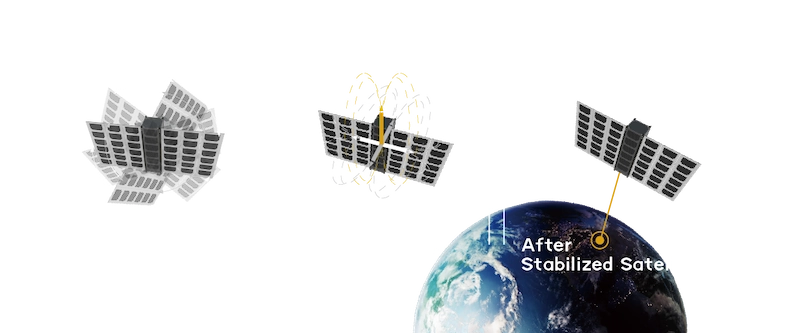
When a CubeSat is first deployed from its launch vehicle, it typically tumbles uncontrollably due to separation forces and residual launcher dynamics. This tumbling state must be eliminated before the satellite can begin normal operations, a process called detumbling. Magnetorquers excel at this critical mission phase.
B-dot Control and Electromagnetic Damping
Detumbling typically employs the B-dot algorithm, which measures the rate of change of Earth's magnetic field as observed by the tumbling satellite. By commanding magnetic moments that oppose this rate of change, the magnetorquer generates damping torques that resist the satellite's rotation; it functions essentially as an electromagnetic brake. Unlike strategies requiring precise attitude knowledge, B-dot control only needs magnetometer data, making it robust and reliable even when the satellite is spinning rapidly and other sensors may be unreliable.
Spin Reduction and Recovery Capability
The detumbling process progressively reduces rotation rates across all three axes, typically bringing the satellite from potentially several degrees per second down to near-zero angular velocity within hours to days, depending on initial tumble rates and magnetorquer strength. This capability ensures that even if a satellite experiences an anomaly causing loss of attitude control, magnetorquers can safely recover the spacecraft to a stable state.
Momentum Dumping
Reaction Wheel Saturation Issue
Reaction wheels provide precise, responsive attitude control by exchanging angular momentum with the satellite body. However, external disturbance torques cause reaction wheels to continuously accumulate momentum in one direction, eventually reaching their maximum speed and becoming saturated. When this occurs, the wheels can no longer provide effective control.
Magnetorquers as a Momentum Sink
Magnetorquers solve this problem through momentum dumping. By generating external torques that oppose the accumulated wheel momentum, magnetorquers transfer angular momentum from the reaction wheels to Earth's magnetic field. This process allows the wheels to spin down to their nominal operating range while the magnetorquers use Earth's planetary-scale magnetic field as an infinite momentum sink.
〈Related Reading:Magnetorquer: Principles and System Integration for Satellite ADCS〉
Complementary Control Strategy
Momentum dumping typically occurs during portions of the orbit where pointing requirements are less stringent, or as a background task during normal operations. The integration of magnetorquers with reaction wheels creates a complementary system: reaction wheels provide high-bandwidth, precise control for immediate maneuvers, while magnetorquers handle long-term momentum management and coarse attitude adjustments. This combination maximizes mission capability while minimizing power consumption and mechanical wear.
Application Scenarios of Magnetorquer in Various Satellite Missions
University Research and Educational Satellites
University satellite programs represent one of the largest user communities for magnetorquer-based attitude control systems. These missions typically operate in low Earth orbit (400-600 km altitude) where Earth's magnetic field provides sufficient strength for effective control. Magnetorquers offer an ideal solution for educational missions due to their simplicity, reliability, and lower cost compared to reaction wheel systems.
Research satellites often employ magnetorquers as the primary attitude control actuator, particularly for missions with moderate pointing requirements (±5-10 degrees accuracy). The technology demonstration nature of many university missions makes magnetorquers attractive, as they provide hands-on learning opportunities in spacecraft dynamics, control algorithms, and systems engineering. Examples include atmospheric science experiments, technology validation missions, and Earth observation demonstrations where mission success matters more than achieving sub-degree pointing precision.
Earth Observation and Remote Sensing Missions
Commercial and government Earth observation satellites frequently incorporate magnetorquers as part of their attitude control architecture, though often in combination with reaction wheels for enhanced performance. For high-resolution imaging missions requiring sub-degree pointing accuracy, magnetorquers typically serve for momentum dumping and coarse attitude control, while reaction wheels handle fine pointing during imaging operations.
However, moderate-resolution multispectral imaging missions and environmental monitoring satellites may use magnetorquers as primary actuators. These missions typically operate in sun-synchronous orbits (600-800 km altitude) with predictable lighting conditions and magnetic field geometry. The ability to maintain nadir-pointing orientation (±2-5 degrees) enables useful data collection for vegetation monitoring, ice coverage tracking, disaster response assessments, and climate studies, all without the complexity and cost of reaction wheel systems.
Communication Satellite Constellations
Small satellite communication constellations increasingly leverage magnetorquer technology for attitude control, particularly in low Earth orbit configurations. These missions require antennas to maintain orientation toward ground stations or relay satellites, a task well-suited to magnetorquer capabilities in LEO environments where magnetic fields are sufficiently strong.
Modern LEO communication constellations benefit from magnetorquers' high reliability and minimal maintenance requirements—critical factors when deploying dozens or hundreds of satellites where individual spacecraft servicing is impractical. The elimination of moving parts reduces failure modes and extends operational lifetime, essential for achieving favorable economics in constellation operations. While geostationary communication satellites at high altitudes cannot effectively use magnetorquers due to weak magnetic fields, the growing trend toward LEO constellations creates expanding opportunities for magnetorquer applications in the communications sector.
Scientific Research and Technology Demonstration
Scientific satellites conducting space environment research, magnetospheric studies, or technology validation experiments often employ magnetorquers for attitude control. These missions may have specialized pointing requirements, such as maintaining instruments aligned with magnetic field lines, monitoring Earth's limb, or tracking celestial targets during specific orbital phases—objectives that magnetorquers can efficiently achieve.
Technology demonstration missions testing new components, systems, or operational concepts frequently choose magnetorquers for their proven reliability. This allows the experimental payload to remain the primary mission risk rather than the attitude control system. The extensive flight heritage and well-understood failure modes of magnetorquer systems provide mission designers with confidence in baseline spacecraft functionality while validating novel technologies or operational approaches.
〈Related Reading:What is a TestBed? Practical Application in Satellite ADCS 〉
Types of Magnetorquers
In spacecraft applications, magnetorquers come in two primary practical configurations, each optimized for different design priorities and mission requirements. Understanding these configurations helps mission designers select the most appropriate solution for their specific spacecraft constraints and performance needs.
Flat Air Coil Magnetorquers
Planar Coil Structure and Integration
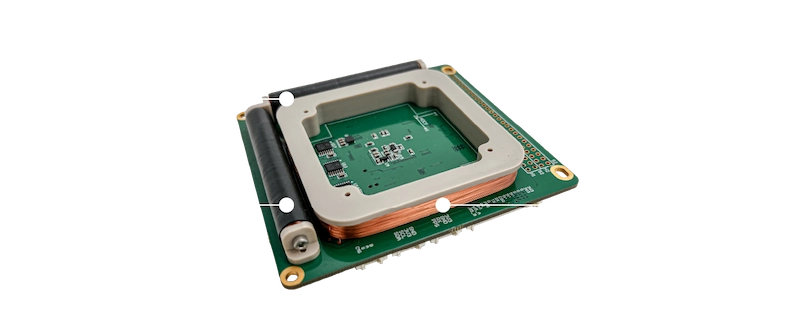
Flat air coil magnetorquers feature a planar design where conductive wire is wound in a flat, pancake-like configuration, typically in a square or circular pattern, without any ferromagnetic core material. This configuration prioritizes minimal thickness and low mass, making them ideal for integration into constrained spaces. The coils can be manufactured using printed circuit board (PCB) technology or wound wire on flat substrates, allowing them to be mounted directly onto structural panels or integrated into solar panel assemblies.
Advantages of Low-Profile Air Coil Designs
The primary advantage of flat air coil magnetorquers is their extremely low profile, typically only a few millimeters thick, which enables mounting on interior surfaces without consuming valuable internal volume. They offer the lightest weight option and provide highly linear behavior where the magnetic moment is directly proportional to input current, with no hysteresis effects. Thermal management is simplified since heat generation is limited to resistive losses in the wire, and the flat geometry facilitates heat dissipation through the mounting surface.
Performance Limitations and Use Cases
However, flat air coil designs generate lower magnetic moments compared to iron core alternatives. To achieve sufficient control authority, they typically require larger surface areas or higher operating currents, which can increase power consumption. These magnetorquers are most commonly deployed in very small satellites (1U to 3U CubeSats) where panel mounting is advantageous and where mission requirements allow for moderate attitude control performance. They excel in applications where mass and thickness constraints are more critical than maximum control authority.
〈Related Reading:Revolutionizing Satellite Attitude Control: Spherical Motor-driven Control Moment Gyroscope〉
Rod-Shaped Iron Core Magnetorquers
Structure and Alignment
Rod-shaped iron core magnetorquers represent the industry standard configuration for spacecraft attitude control. These magnetorquers consist of a cylindrical ferromagnetic core (typically made from iron, silicon steel, or permalloy) wrapped with multiple layers of conductive wire. The elongated geometry naturally aligns with spacecraft structural elements, allowing rods to be positioned along the satellite's edges, frame members, or dedicated mounting brackets.
Magnetic Amplification and Performance
The ferromagnetic core dramatically amplifies the magnetic field generated by the current-carrying coils. The high magnetic permeability of the core material concentrates and intensifies the magnetic flux, allowing iron core designs to achieve magnetic moments three to ten times higher than equivalent air core configurations of similar size. This amplification effect means smaller, more compact magnetorquers can meet stringent attitude control requirements, making them highly effective for performance-critical missions.
Advantages and Thermal Management
Rod-shaped iron core magnetorquers offer several significant advantages. The cylindrical form factor provides efficient use of interior volume while maximizing magnetic moment per unit mass. The elongated surface area facilitates excellent heat dissipation along the rod's length, improving thermal performance during continuous operation. The robust mechanical design withstands launch loads and provides reliable long-term operation in the space environment.
Design Considerations and Limitations
Design considerations include the additional mass of the core material compared to air core alternatives, though this is typically justified by the substantial performance gain. Engineers must account for hysteresis and saturation characteristics of ferromagnetic materials, which can introduce minor control nonlinearities at very high current levels. Core losses contribute additional heat generation beyond resistive wire heating, requiring appropriate thermal management in the spacecraft design.
Applications and Mission Suitability
Despite these considerations, rod-shaped iron core magnetorquers are the preferred choice for the vast majority of spacecraft missions. They are used extensively in CubeSats (1U through 12U), small satellites, and even larger spacecraft platforms where magnetic attitude control is employed. Their combination of high performance, reasonable mass, proven reliability, and widespread flight heritage makes them the pragmatic solution for mission designers requiring robust attitude control capabilities.
Selecting the Right Configuration
Type of Magnetorquers
The choice between flat air coil and rod-shaped iron core magnetorquers depends on mission-specific constraints and priorities. Mission designers should evaluate their spacecraft's available mounting locations, mass budget, power budget, and required control authority. For very small satellites with limited internal volume and relaxed pointing requirements, flat air coils offer an elegant, lightweight solution. For missions requiring robust attitude control, rapid detumbling, or precise pointing, rod-shaped iron core magnetorquers provide the performance and reliability needed for mission success.
In practice, many spacecraft employ a hybrid approach, using a combination of both configurations to optimize for specific axes or operational modes. The flexibility to select and combine different magnetorquer types allows designers to tailor attitude control systems to their unique mission requirements.
〈Related Product Recommendations:MTQ & MTQ BOARD Magnetorquers〉
Conclusion
Magnetorquers serve essential functions throughout a satellite's mission lifecycle, from initial detumbling after deployment to long-term attitude stabilization and momentum management in hybrid control systems. The choice between flat air coil and rod-shaped iron core configurations depends on mission-specific constraints, with each design offering distinct advantages for different operational scenarios.
Understanding these practical applications, from university research platforms to commercial Earth observation and communication satellites, enables mission designers to make informed decisions about attitude control architecture. Whether magnetorquers serve as primary actuators or complement reaction wheel systems, their reliability, simplicity, and proven flight heritage continue to make them valuable for modern spacecraft.
In our final article, we'll explore the critical design and selection considerations that determine optimal magnetorquer specifications for your specific mission requirements.
Need guidance on magnetorquer configuration? Contact Us to discuss your mission and explore Tensor Tech's TensorMTQ solutions.